
For this HOCR evaluation, I decided to break down the course into sections and reflect on each section because it was such a steering-focused regatta. If you want to check out my other evaluations, you can read the HOA 2016 one here, HOP 2018 one here, and Gold Rush one 2019 here. As much as I loved training for and racing at this year’s Head of the Charles, the timing could have not been worse. I was starting a new job that was much more demanding and was in a new industry. However, if I’d dropped out of the race, my regret would have been bigger than the CRI boathouse. It was an opportunity I did not want to lose, and I was ready to sacrifice a lot for that. The study sessions with my coxswain besties were incredibly helpful and therapeutic. When it was time to fly to Boston, I felt absolutely ready.
Warm-up
Could this warm-up/traveling lane be any narrower? I could not believe I did not hit the shore, a buoy, or a person watching the race.
I don’t think I had to row by pairs too much. It was nice following our other boat in the same event.
Start
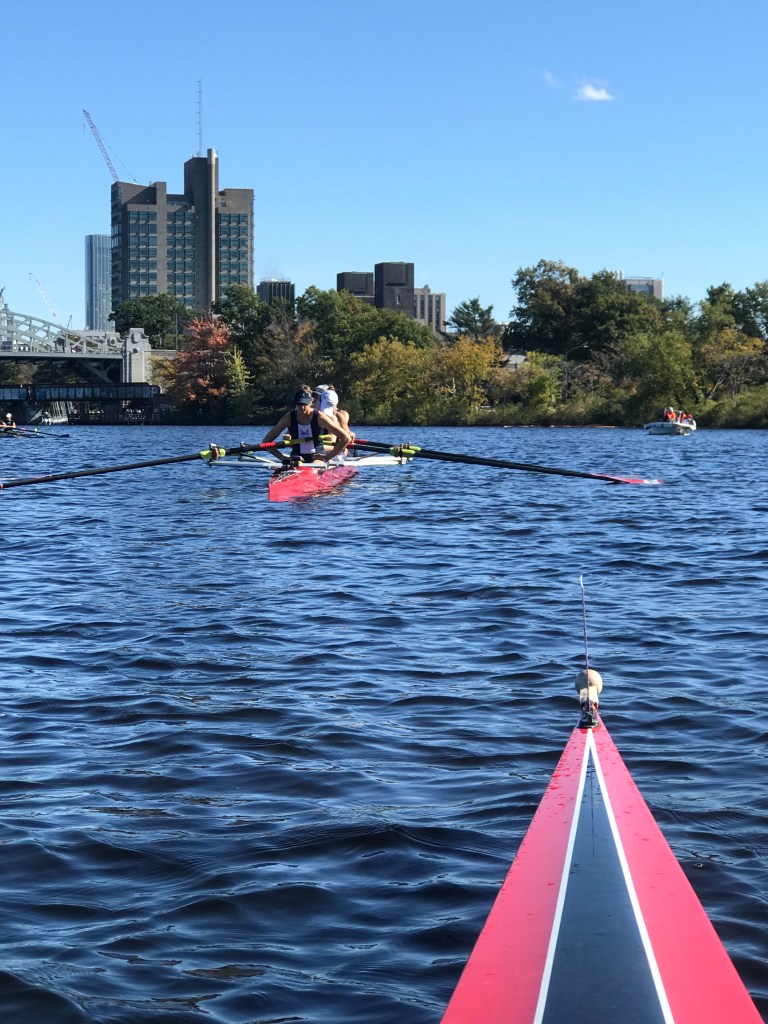
My Head of the Port (the only regatta our line-up raced in before HOCR) start was baaaad. All the starts I practiced during training were baaaaad. However, on race day, I got my rowers going before we crossed the line, and we were exactly two stroke in at race pressure when we crossed the start line!
Start to 1K
The BU Bridge is pretty narrow! The way it crosses with the other one messed with my perception during the practice row on Friday, so I was very focused on leaving enough room on both sides for the blades.
Yay: Went over the buoys
Boo: Pretty sure we hit at least one of the buoys.
1K to River Street and Western Avenue bridges
I let the rowers know when I was coming off the buoy line.
Gave them a specific target when we made a move. This is something the rowers asked me to do. We had no boats to pass or make a move on, but we talked about using the Powerhouse Stretch to shave off some time since it was one of the few spots we could go straight for a while.
Called power 10 when the SpeedCoach said 1k… Even though I told the rowers I would tell them 1k, 2k, 3k, etc., I only called 1k during the race. I forgot. Also, I couldn’t read the screen of the SpeedCoach that time of the day (Our event started at 1:50 PM), and that’s not something I was prepared for. If I didn’t have Jill’s CoxBox with the fancy screen that told me everything, I would’ve been so screwed.
Anyway, I took the arches on the Cambridge side because there was too much traffic in the middle. It was the right call. We passed a boat that was going through the middle arches. The rowers knew we were passing and did an awesome job riding that momentum through the next bridge.
Western Avenue Bridge to Weeks Bridge
Was able to point at the blue dome with no other traffic around me. Once I started turning on the rudder at the Turning Tree, I saw that my boat was going to hit the bridge. I got scared and backed off a little bit and did not call the starboard power right away. I was rudder only for TWELVE strokes. Once I was going under the bridge, I saw that I was not as close as I thought I was. I was shitting my pants, though. I give my Weeks turn 3 stars out of 5.
Weeks Bridge to Anderson Bridge
Our power coming out of the turn was great. I read the data to the rowers, but I should’ve fired them up by letting them know that it was impressive to stay on our power and our rhythm through that sharp turn.
I did the Anderson turn with rudder only at first and thought I could get away it but ended up calling for port pressure.
Anderson Bridge to Eliot Bridge
Right after Anderson, I started to prepare the rowers to pass a boat. “We are going to go for it at the 2-mile marker.” Then I changed my mind lol and started our move a little before we got to the marker.
After the race, the rowers talked about how exhilarating this pass was. I listened to the recording and it takes TWO FULL MINUTES to pass another coxed 4. It felt so long, and I never doubted my rowers because I could tell our speed was faster, but oh my gosh, the longest two minutes of the race.
The boat we were passing was excellent, and I learned from that coxswain too. He did not yield right away because he probably thought I was calling yield a little too soon, and I think I was too. Then the second time I called for it right behind them, the stroke of that boat gave me a nod as if to say, “We heard you. We are yielding.” and the boat moved outside for me. No scary moments, no collision, no oar clashes. Just a clean yield. THANK YOU!
Eliot Bridge to straight course
Could’ve gotten off the buoy line sooner to get my line ready for Eliot. Could’ve gotten closer to the Belmont dock. I got lucky again and did not have much traffic.
Eliot Bridge to the Finish
Our sprint was epic. I was instructed to keep going up as high as possible, and we jumped the stroke rate quite a few times and every time, we increased the rate while lowering the split. Had to do a ratio call once, but that was all fine. We all knew the ratio call was our medicine to everything.
I called “Legs 5” with 5 strokes to the finish line. I could tell I was close, but I didn’t have it in me to say, “Last 5” in case I was not correct. It ended up being exactly 5 strokes from the finish line.
 Coxswain's Log